
Schedules reference
The declarative reference for schedules: the trigger schema, the older standalone
schedules block, the self-MCP tools a keeper uses to manage its own schedules,
and the REST surface behind the Triggers tab.
The trigger schema (schedule)
Section titled “The trigger schema (schedule)”A schedule is a trigger persisted in a project’s project.yaml under the
triggers map, keyed by name. Each trigger is trigger (when) +
run (what) + enabled:
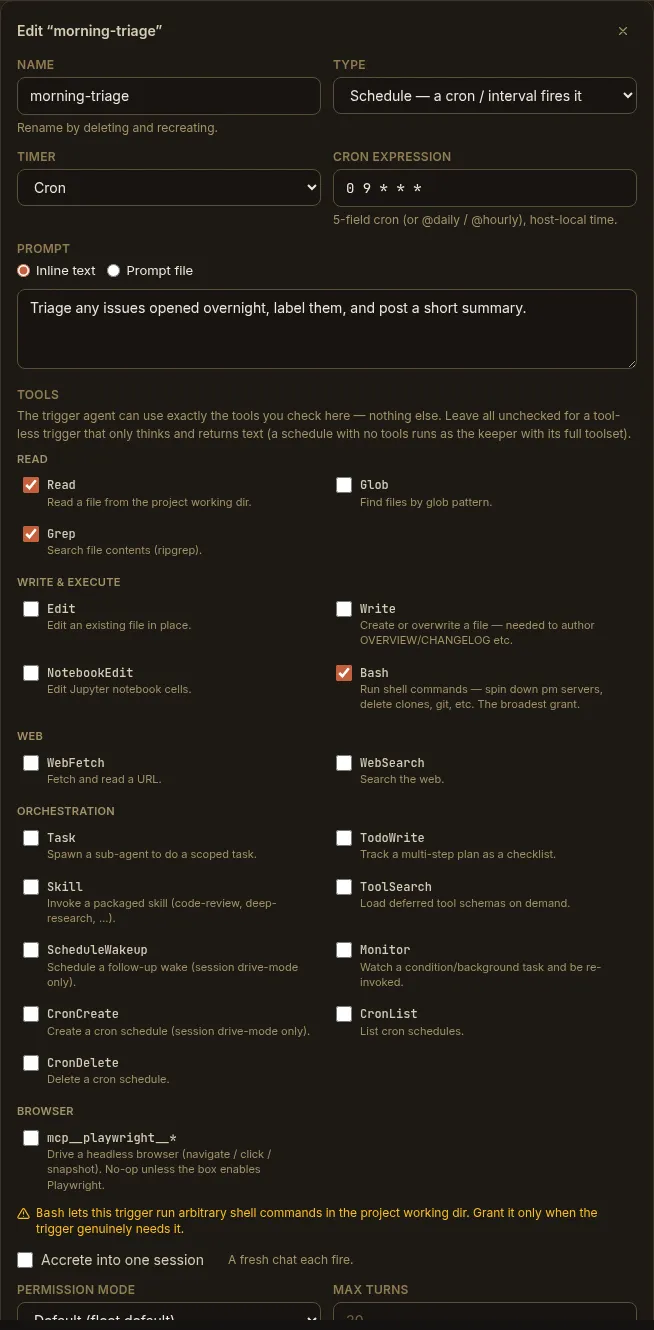
triggers: morning-triage: trigger: # WHEN — the schedule type: schedule cron: "0 9 * * *" # 5-field cron (or @daily / @hourly), host-local # interval: "30m" # …or a duration; exactly ONE of cron / interval run: # WHAT — the fired agent turn prompt: Triage overnight issues and post a summary. # promptFile: triage.md # …or a .md file under .paddock/triggers/; exactly ONE session: new # "new" (default) | "resume" tools: [Read, Grep] # allow-list = capability; [] = run as the keeper model: "" # optional model override permissionMode: acceptEdits # default | acceptEdits | bypassPermissions | plan maxTurns: 30 # optional cap (default 30) maxSpawnDepth: 0 # optional; 0 = may not spawn children enabled: trueThe fields:
| Field | Values | Notes |
|---|---|---|
trigger.type | schedule | The discriminant. Triggers can also be event (an onArchive / afterTurn lifecycle event) or webhook — the latter is shape-reserved but not yet fireable (no inbound ingress yet). The afterTurn event is reserved for the built-in sweeper/curator. |
trigger.cron | 5-field string | e.g. 0 9 * * *; @daily / @hourly accepted. Host-local time. |
trigger.interval | duration string | e.g. 30m, 1h, 15m. |
run.prompt | string | The instruction the firing runs. |
run.promptFile | *.md name | Read fresh at firing from .paddock/triggers/; traversal and non-.md are rejected. |
run.session | new | resume | new (default) = a fresh chat each firing; resume = one owned accreting session. |
run.tools | string array | The fired agent’s allow-list. Empty (default) = runs as the keeper with full tools; non-empty = its own scoped trigger-<slug>-<name> agent with exactly those tools. |
run.model | string | Optional per-trigger model override. |
run.permissionMode | default | acceptEdits | bypassPermissions | plan | Permission mode the fired turns run under. |
run.maxTurns | integer | Upper bound on agent turns (default 30). |
run.maxSpawnDepth | integer ≥ 0 | Bounds internal spawning (0 = may not spawn). |
enabled | boolean | Whether it’s armed. A trigger created through the UI or MCP defaults to disabled. |
The schedule editor maps one-to-one onto this schema:
The legacy schedules block
Section titled “The legacy schedules block”Before triggers were unified, schedules lived in their own top-level schedules
map. That form is still honored and armed — a simpler shape when you only need
a timer:
# project.yaml — legacy standalone schedules (still supported)schedules: nightly-scan: type: cron # cron | interval cron: "0 3 * * *" prompt: Scan for dependency advisories. resume_session: false # note: snake_case here (false = fresh chat each fire) enabled: trueNote the differences from the unified run block: resume_session (snake_case)
in place of session: new|resume, and promptFile here resolves under
.paddock/schedules/ rather than .paddock/triggers/. New work is better
expressed as a triggers entry (it’s what the Triggers tab and the MCP tools
read and write), but existing schedules blocks keep working.
Self-MCP tools
Section titled “Self-MCP tools”When the trigger-management MCP is enabled
— the self-MCP write layer (PADDOCK_SELF_MCP + PADDOCK_SELF_MCP_WRITE) plus
PADDOCK_HOOKS_MCP (or a per-project hooksMcpEnabled) — the keeper is given three
tools. They manage every trigger type; for a schedule, use type: "schedule".
set_trigger
Section titled “set_trigger”Create or update a trigger (a partial patch — an enabled-only call just flips the
toggle). Parameters (note the snake_case MCP argument names):
| Parameter | Type | Notes |
|---|---|---|
name | string | The trigger’s stable key. Required. |
type | schedule | event | webhook | Omit on an edit to keep the existing when. webhook is reserved (not yet fireable); afterTurn events are reserved for the curator. |
cron | string | For a schedule: a 5-field expression (host-local). Exactly one of cron / interval. |
interval | string | For a schedule: a duration (30m, 1h). |
prompt | string | Inline instruction. Provide this or prompt_file. |
prompt_file | string | A .md file under .paddock/triggers/, read at firing. |
session | new | resume | new (default) = fresh chat each firing; resume = one owned session. |
tools | string / array | Allow-list (one per line, comma-separated, or a JSON array). Empty = tool-less/keeper. |
model | string | Model override for the fired agent. |
permission_mode | default | acceptEdits | bypassPermissions | plan | |
max_spawn_depth | number | 0 = may not spawn. |
max_turns | number | Caps the fired turn. |
enabled | boolean | Defaults false on a new trigger; omitted on an existing one leaves it unchanged. |
project | string | Target project slug; omit for the current project. |
list_triggers
Section titled “list_triggers”List a project’s triggers (all types) — what’s declared, and their state.
remove_trigger
Section titled “remove_trigger”Delete a trigger by name.
REST endpoints
Section titled “REST endpoints”The Triggers tab drives the unified trigger surface. These endpoints are always available (they don’t require the schedule-mutation gate):
| Method & path | Purpose |
|---|---|
GET /api/projects/:slug/triggers | List triggers + the picker catalog (grantableTools, events, triggerTypes). |
GET /api/projects/:slug/triggers/:name | Get one trigger. |
PUT /api/projects/:slug/triggers/:name | Create or replace one trigger (full { trigger, run, enabled } record). Enable/disable is this call with enabled flipped. |
DELETE /api/projects/:slug/triggers/:name | Delete and disarm one trigger. |
The older standalone schedule endpoints also remain. Their mutating routes are governed by the schedule-mutation gate:
| Method & path | Purpose |
|---|---|
GET /api/projects/:slug/schedules | List the legacy schedules block (+ mutationEnabled). Ungated. |
PUT /api/projects/:slug/schedules/:name | Create/update a legacy schedule. Gated. |
DELETE /api/projects/:slug/schedules/:name | Delete a legacy schedule. Gated. |
POST /api/projects/:slug/schedules/:name/:action(enable|disable) | Flip enabled. Gated. |
POST /api/projects/:slug/schedules/:name/trigger | Fire a legacy schedule now (useful for testing). |
Next steps
Section titled “Next steps”- Schedules — the concept.
- Scheduling recurring work — the hands-on guide.
- Scheduling configuration — the deployment gates.